State News (Michigan State U)
Nov 10, 2005 |
By BENITA MEHTA
Hanson is not the same band it was eight years ago when "MmmBop" took over the airwaves with its infectious pop melody. These days, the grown-up trio of brothers isn't just creating more pop songs — they're spreading a message about the evils of major labels.
The band is touring college campuses to talk about the state of the music industry and show their self-made documentary about their struggle with Def Jam Recordings and switching to an independent label.
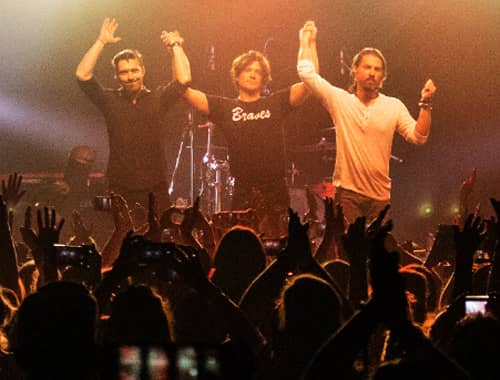
Although Hanson wasn't able to show their documentary "Strong Enough to Break" at MSU, the band still came to campus Tuesday afternoon to play a three-song acoustic set in the Union and do a radio interview on The Impact on WDBM (88.9-FM). The band will also be playing a full-length concert tonight at the Royal Oak Music Theatre in Royal Oak.
Taylor Hanson, the middle brother, said the band is essentially doing two tours at the same time: one playing shows to promote their new live album, which was just released on Oct. 11, and one to talk to college radio stations and students about their documentary's message.
"There's something wrong with the industry when the business doesn't care as much about the music as it does about profits," Taylor, 22, said. "We want to help rebuild the business and get it back to music."
There was a big merger in 1999 with their label and some others, Taylor said, and Hanson was moved around to different labels.
"Our story is an example of what bands go through on major labels," Zac Hanson, who recently turned 20, said. "In order to be the band we wanted to be, we had to become independent."
Isaac Hanson, the oldest brother, said the band felt like being on a major label was all about politics and stock prices.
"It's an epidemic in music," Isaac, 24, said. "Labels aren't playing a positive role in encouraging college radio stations and music."
Taylor said their focus is on college students because they are the ones who have the ability to choose what they play on their radio stations and can encourage others.
"We could have gone out and gotten advertisers and produced our movie for distribution, but we chose to come to schools and talk to college DJs and journalists about our message," Taylor said. "We wanted to talk to people who can still control the music industry by playing and writing about what they want."
The band said New York University and the University of South Carolina [California] even included the documentary as a part of class programs.
Taylor said Hanson doesn't care whether people like their own music, but they want music fans to hear their message.
"Growth in the industry happens when people like college students give radio stations feedback on what they want to listen to and by forming online music communities to promote indie labels and local bands," Taylor said.
Hanson is not performing their concerts on college campuses because they want to differentiate their music from their message and documentary, Taylor said.
Their goal is to encourage more radio stations to play independent artists and stop radio stations from playing repetitive playlists.
"We want people to learn about new music and independent bands," Taylor said. "The reason no one listens to the radio anymore is because they can make their own playlists on their iPods, and the stations are playing music they don't want to hear."