Hanson Interview at the Bottom Line (10/1/2003)
Oct 13, 2004 |
To allow more creative expression on their third studio album, Underneath, brothers Isaac, 23, Taylor, 21, and Zac, 19, formed the independent 3CG Records. “In the industry, there’s been a lot of production, a lot of marketing, a lot of push on these artists, entertainers, and performers. I think people are just probably excited to see things that speak to them in a more organic way,†said keyboardist Taylor.
Though Hanson has often been placed in a box, the band just keeps finding ways to punch air holes. In both Underneath and this Bottom Line interview, Hanson goes beyond the “MMMBop†illusion to reveal its blues-based roots and evidently untapped potential.
Your music has a paradoxical effect: On the A side of the ’45, you’ve won the industry elite’s approval. On the B side, however, a lot of America could never tell the difference between a Hanson and a Backstreet Boy.
Do you think Underneath will redefine you to the public?
Zac: Well, as an artist, you hope to grow and change with your audience and to be relevant to people through your entire career. Really, you’re just shifting naturally, where the band goes, and I think the audience is also growing and changing. Since the first record, it’s been six years, and the second record, three. People are older and different than they were. Most of our fans are really in college by now!
Isaac: You want to cover as many grounds as possible, because music is not just for one group.
Taylor: It’s just about getting across to people who you are and about being relevant to your audience, whether it’s a 12-year-old girl who just heard Hanson or a 45-year-old guy who decides, ‘Wow, Hanson is really great!’ Like any album, we’re just excited to continue to hammer home who we are, and hopefully, we’ll get to keep doing it.
While some of your contemporaries were lip-synching at concerts, you did an unplugged tour, as just a three piece band. Did you at times feel vulnerable on stage?
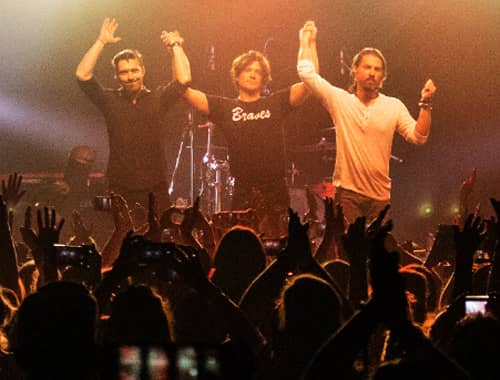
Taylor: Well, this is what we do- we wake up in the morning and we’re musicians. This is really almost more true to what we do than the studio.
Zac: It’s more like bringing people into the songwriting sessions. It’s more liberating.
Isaac: Part of being an artist is making yourself vulnerable.
Underneath contains some very impressive liner notes- Danny Kortchmar, Matthew Sweet, Gregg Alexander, etc. How do you meet up with such artists- is it like a recruitment process?
Zac: Yeah, it’s like songwriting boot camp!
Well, actually, we read that you attended Miles Copeland’s Songwriting Camp a couple of years ago…
Zac: Well, that’s a fun thing that’s been going on for years now. We just had a friend who knew about that, and he was like, ‘Oh, you guys should come,’ and we’re like, ‘it sounds like fun to me.’
So then, please tell America- what is it really like at band camp?
Zac: Yes, Band Camp! (In a Simon Cowell voice): You go as a normal Joe, and come back as a rock artist! It’s a funny misconception, band camp. There are no classes- it’s not learning. It’s a bunch of talented people, and they just go, ‘How do we get together, and have a whole lot of fun, making music?’ You go there, and you drink wine, and you write songs, and you record stuff…
Taylor: Yeah, you eat a lot of food, drink a lot of coffee, stay up really late…
Isaac: Debauchery!
Taylor: It’s just a much smaller world than you’d think… you know, by the time you get in a room, musicians are just musicians. We have a producer on Underneath (Bob Marlette) whose background is basically metal- Marilyn Manson, Alice Cooper, and Saliva- and we produced one of the more melodic songs on the whole record with him. We also worked with a guy who produced Rufus Wainwright (Greg Wells) and someone who had a career of working with James Taylor and Carole King (Danny Kortchmar).
Isaac: A lot of what people forget is that popular music in general basically started in one place- blues. You have blues…
Zac: Gospel, R&B…
Taylor: Rap, rock and roll …
Isaac: Basically, in the ‘40s, blues and Gospel started to really evolve into rock and roll and R&B.
You influenced a lot of young, credible musicians, like Michelle Branch. How do you feel about the Frankenstein effect you had on late ‘90s manufactured pop groups?
Taylor: Yep, we created a monster. But for us, it’s really about putting out music, and if we happen to be in a position that we can give opportunities, then we’ll do it….Another thing is the guests on the album-the younger guests like Sam Farrar from Phantom Planet, Michelle Branch, David Garza, who is unbelievable, and other artists who we’ve begun to connect with, like Maroon 5 and Ben Kweller. Every time we make an album, we really are excited about building this young community of artists.
Isaac: No matter what, as an artist, you are constantly hoping to inspire artists, because that is what makes it all worthwhile.
Zac: And if you’re not doing that, then you’re not doing your job, and you should just stop!
Now that you’ve made the rounds a few times- recording three studio albums, promoting around the world, launching full-scale tours- has a favorite phase of the cycle emerged yet?
Zac: I think with each phase, you can’t wait to do the next phase, and then the next phase…
Isaac: I’m not sure about the promotional phase…
Zac: Well, when you’re promoting, you want to get back into the studio, because you can’t wait to record the songs that are in your head. And when you’re in the studio, you can’t wait to get the music out and be promoting it so people will know it’s out, because you love the songs you do, and then…
Taylor: (In all severity) It’s a vicious cycle.
Isaac: It’s the only thing that keeps you going.
Zac: Every part of the industry and the cycle has its own special meaning. But obviously, making the music comes first.
You’re music industry entrepreneurs, in both the business and artistic sense. Do you have any insights to offer young adults?
Taylor: First of all, it’s really about having the drive to not give up. It sounds very cliché…
Zac: Very.
Taylor: For us, we’re guys in a band, we’re starting out- from the very beginning, no matter what anybody around here says, you’ve got to keep at it. Plus, you’ve got to surround yourself with people that you trust.
Isaac: You find that the expression is very, very true- ‘90% perspiration, 10% inspiration.’ That’s really one of the main things it comes down to- your passion for what you do. That goal, that objective, whatever it is you love to do- whether it be music, or starting a consulting firm, I don’t know- your goal and your passion is really what guides everything.
So, on your tour bus, what CDs have been spinning in your Discmans lately?
Zac: A lot of new, upcoming artists. Ben Kweller, Maroon 5, Phantom Planet, Wes Cunningham, who’s an independent artist, Bleu…
Isaac: Oh, Bleu, definitely!
Zac: There are a lot of new, great upcoming artists. There really is some great music out there. It’s funny, to be a musician, you’re not necessarily up on what’s “hot,†because you’re on tour- you’re up on what’s “not!â€
Taylor: We mentioned this community of artists- that’s what kind of excites us about starting our own record company, is the future. Whoever they a