Free Williamsburg
Sep 18, 2005 |
An interview with the dreamy one, Taylor Hanson
by Monte Holman
The eyebrows are back! Former boy sensations, Hanson, are storming the music industry with the passion of proselytizers for the cause of independent music. A struggle to survive in the pick-of-the-day major label system in which bands are discarded like non-recyclable take-out boxes drove Hanson to drop Geffen and start their own label. They now fervently preach the Good News of independence.
But their Starbuckian jargon sounds awfully suspicious. Discussing the band using terms like entrepreneurship, brands, markets and models seems to transplant the evil concerns of the big labels into a new setting. An increasing familiar setting in which indie bands capitalize off the OC and Target.
Thing is, Hanson are likable kids, er, young adults, who obviously love music but grew up under the thumbs of soul-sucking record execs. It's impossible to stoop to the usual cynicism directed toward commercial bands when these three brothers are trying so earnestly to do something about it. Like really earnestly, man. So their upcoming album, The Best of Hanson, Live and Electric (3CG), may not be your cup of tea. But I'll be damned if you could talk **** about these guys after hearing them out for a few minutes.
We were recently offered the opportunity to speak with Taylor. The dreamy one. How could we refuse? Via phone, Taylor explained the band's philosophy, which when his awkward industry lingo was boiled away, amounted to keeping two things sacred: the music and the fans.
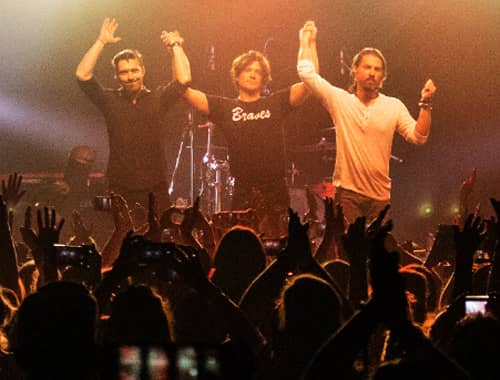
Hanson is Isaac, Taylor and Zac Hanson.
FREEwilliamsburg: The title of the new record is The Best of Hanson, Live and Electric. Why go with a "best of" at this point? What spurred the desire to put out a live album?
Taylor: It's become really trendy to put out a "greatest hits" or "best of" too early. It's spawned by a major label idea to try to put out hits. But for us, it's more about the "live and electric" part. And it's a "best of" because when you play shows and you've been a band for like 13 years and have released multiple albums, you've got a certain amount of songs that are the best of songs, the ones people know and react to live. It's not as much a greatest hits package as a reinterpretation of what we've done for the last decade or so. It's about framing who we've always been.
FREEwilliamsburg: You include a Radiohead cover and a U2 cover. Why those particular bands and why do covers at all on this sort of album?
Taylor: It's a representation of some of our influences. U2 probably more than Radiohead. U2 is such an icon right now. There are so few great bands. They're one of the greats right now-they are dishing it out. They're a real inspiration to us just as a band who's had such an arc in their career. I love that song ["In A Little While," from All That You Can't Leave Behind]. With Radiohead, that song ["Optimistic", from Kid A] is a seismic song. We started off almost every show the last two years on tour for Underneath with it. We wanted to start things off with a sort of brace-yourself, larger-than-life, electric feeling. That song is really dynamic, and it does that for people. It's really unexpected for someone listening to a Hanson album, and also it's really a lot more of an example of who this band is in a sense of its versatility, pushing yourself and always throwing something in there that's in the realm of what seems like what you'd expect to get.
FREEwilliamsburg: As evidenced by the songs on the live album, there seems to be a progression from an R&B influence when you guys first started out to straight up rock and roll in more recent songs. Is that something you've consciously moved toward, or did it come naturally?
Taylor: You have a natural meeting of the minds as you make each record. You're right - with that first record, where we came from, the biggest inspiration was old R&B. Aretha Franklin and Otis Redding, stuff like the Eisley Brothers-great classic R&B. And old rock and roll, you know, Elvis and the Beatles. You see that a lot more on the first record, and on the second record there were more rootsy songs like "This Time Around." And then Underneath becomes more straight-up rock influenced by more alt-country and mellower bands like Travis, like Jayhawks. Those are some of the things that leaked into the writing process on the last album. A natural evolution happened.
But what Live and Electric does is ties all that together and says, "bands change as they should, and they're all one."
I love going to shows, and I don't want to hear the same song like 30 times. I want to go through an experience, I want to go up and down, I want to rock a little bit, I want to pull my lighter up a little bit, and jump around a little bit. That's what we tried to do with this record, to create what you feel at a show.
FREEwilliamsburg: A lot of talk around you guys is the move toward independence. For a band who's had a lot of success and sold a lot of records within the major-label system, why decide to go indie?
Taylor: What you've got to remember is that the old label system, or the major-label system, used to be a lot closer to what the indie-label system is now. When we came out, it was sort of the last breath of the real major record companies. When the record companies still operated much closer to an indie in a sense that you had people that were running labels that had been there a long time, more artist-relations people, more thinking, real investment in brands.
What's happened over the last five to eight years is this dramatic shift of consolidation, corporate turnovers and a lot of labels hiring a lot more accountants than people that know music. It's actually a lot like us saying we want to stay on the same path we started with, which is to work with people that believe in their fans and in long-term and a career and not alter that because we're afraid of leaving a major label and go on a system which has become more about stock prices. The attention span is so short. People don't realize who this band is always been because we're so young, and it's hard to get over that stigma of "wow, they're so young." But we've always been really hands-on, almost too hands-on where people are like "dude, you don't have to be involved in everything.
That level of passion is the way we operated from the beginning. As we began to clash with this system that was changing and becoming more and more corporate and more removed from music and from the music we make, we were like "look, this isn't the way records should be made, and this isn't the way careers should be made."
FREEwilliamsburg: What has the response been from peers, other musicians, to your move toward being independent?
Taylor: It's been really awesome, actually. For me, those relationships are really important. In the pop-rock genre, especially all the whiteys have really missed the idea of communities, have really overlooked the idea of sharing and creating a movement, a wave, and working with one another. In rap and R&B, there's a real connection from one artist to another. Especially since we started the label, the band has become more passionate about the importance of building those relationships with other artists. For instance, on Underneath, Michelle Branch-she's a friend-sings on the record. Sam Farrar, who's the bass player in Phantom Planet, plays on the record. Matthew Sweet, we wrote with Matthew on the record. Greg Alexander from the New Radicals, who used to be in the New Radicals, is on the record.
Those are different artists doing different things, and an extension of that is something I think is really important. It's like if you don't have artists who are looking at one another and realizing they're part of a greater whole, and nitpicking over this insular vibe, then you can't exhibit the sense of a movement or the sense of e